

One of the things I enjoy most about my job is that it is grounded in genuinely helping brands and businesses grow. While it regularly requires creativity, it also requires a very analytical and critical mindset. This means decisions we make as marketers are grounded in the best available source of proof and evidence available to us.
Of course, this is best to come from your own brand and business data. I’ll get into some practical questions you can put forward to your measurement teams later on in this article that might challenge data available to you. But I wanted to spend the first half of this blog sharing my (perhaps slightly oversimplified) perspective on the latest “Profit Ability 2” research from ThinkBox.
This is an incredibly insightful and reliable source that we have as agencies and marketers, outside of our own Media Mix Modelling, on how advertising genuinely drives profit & growth. The study analyses £1.8 billion of media spend across 141 brands, using robust Marketing Mix Modelling to understand what actually works. It also challenges us to look at our own measurement and effectiveness approaches in new ways, particularly around how we capture both immediate and sustained effects across all channels.
The main consideration worth noting is that the data skews towards bigger brands (usually ones who can afford MMM and econometrics), however the principles it uncovers are invaluable for any brand trying to build a business case for advertising and expand into new channels too.
I’ve found myself referring back to it on an ad hoc basis to pull out bits of insight that might help contextualise conversations I have with my brands and clients. However, until now, I hadn’t taken time to sit down and review all the key takeaways.
Now that I have, I’ve found some insights particularly interesting. There’s a lot to unpick in this research, so I’d highly recommend going to read through in your own time, but here is my two pence on the three areas that were most insightful for me.
The “Brand vs Performance” Divide
Les Binet & Peter Field told us this all nearly 10 years ago, but the battle continues, with seemingly even more evidence required to prove this point – so here it is!
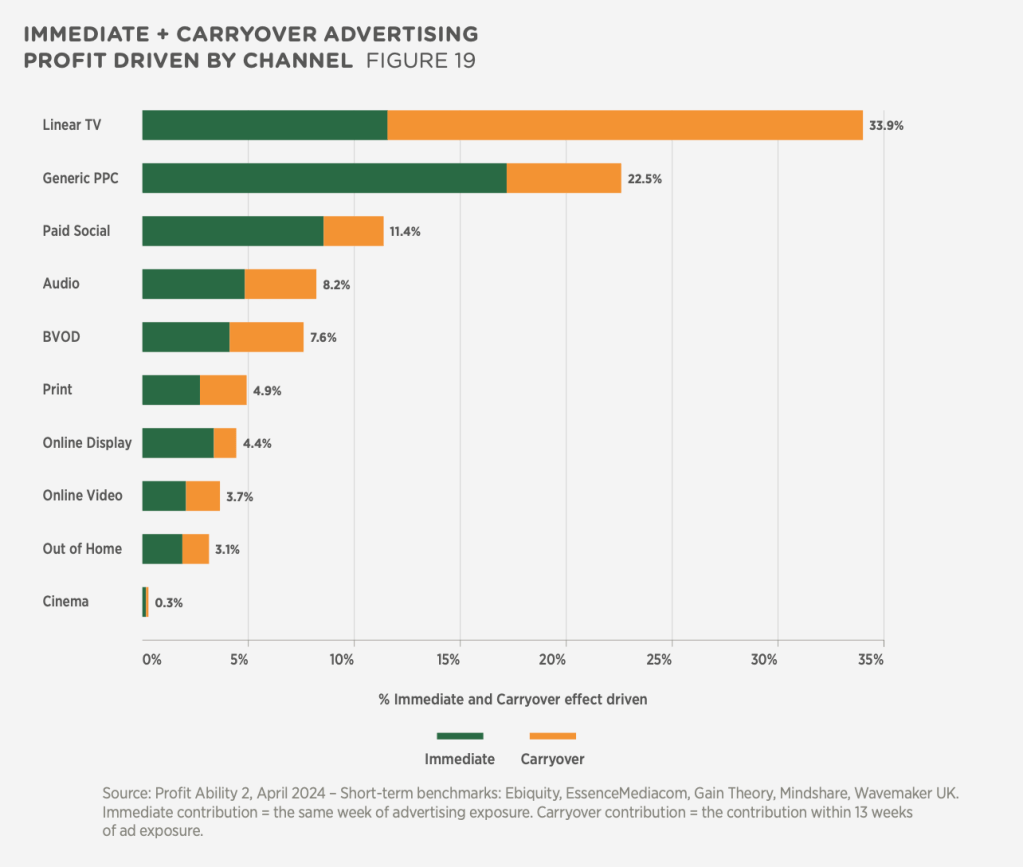
Linear TV is still seen by many businesses as a brand-building, long-term driving media channel. However, this research continues to show its ability to perform in the short term, with immediate profit effects (meaning effects within the same week) at 20.5%, just behind Generic PPC (30.5%). Audio and BVOD also deliver strong immediate effects. This suggests that brands restricting themselves to just “digital channels” aka search and social, for immediate response, are leaving money on the table.

When also looking at the carryover effect you can see the true channel hierarchy for both “short and long term” – showing that Linear TV delivers the most media-driven profit in terms of volume. When optimising channel mix at slightly longer intervals (usually 3 months for most MMM readouts) nothing rivals Linear TV for scale – Generic PPC also continues to be important here. It can also be argued that 3 months is still a relatively short window for optimisation, again highlighting the point that digital channels aren’t the only ones that can deliver quick payback.
The Rising Effectiveness of BVOD
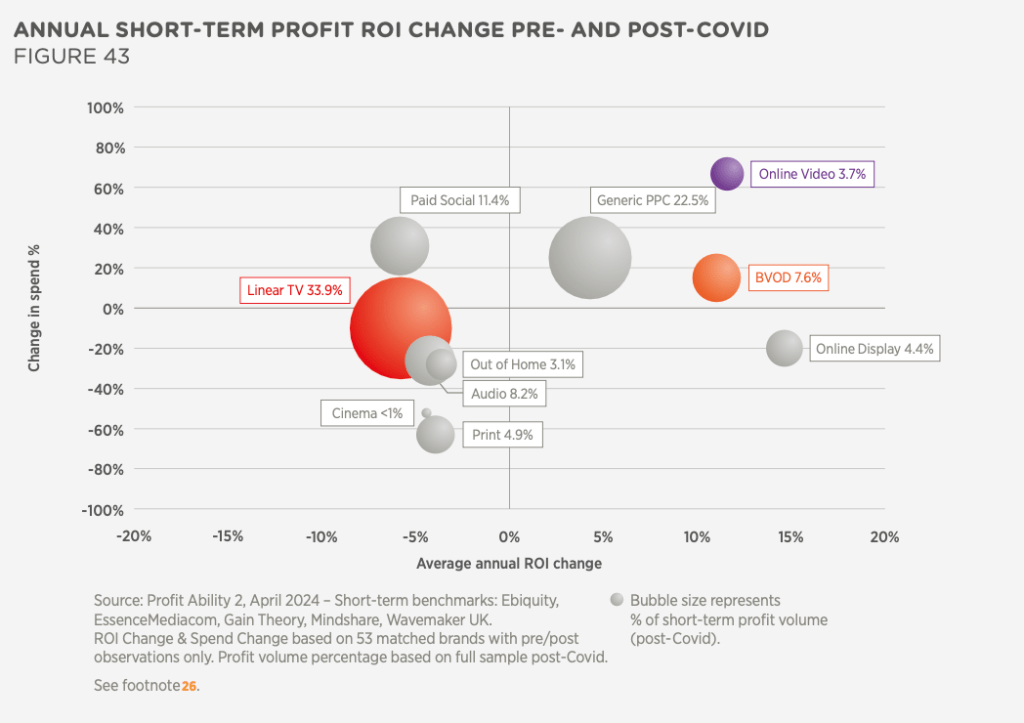
BVOD represents an increasingly valuable opportunity. Its ROI has increased by 10.7% since pre-COVID, and it now delivers above-average returns (£4.25 vs the all-media average of £4.11).
88% of BVOD viewing happens on large screens in what this research calls “permanent peak” viewing conditions. This means viewers are actively choosing to watch content at their preferred time, often for big dramas and specials. This appointment-to-view behavior creates highly attentive viewing conditions which is backed by Thinkbox’s 2024 Content Effects research.
For brands targeting younger audiences, it can actually work out cheaper and more profitable than Linear TV. This makes it an attractive option for brands who might find Linear TV’s entry costs challenging.
A Critical Eye On Social
Perhaps most provocatively, the data suggests many brands are over-invested in social media. While Paid Social has seen a 31% increase in spend since Covid, its ROI has actually declined by 5.9% – the largest efficiency drop across all channels – delivering a full ROI of £3.20 (below the all-media average of £4.11).

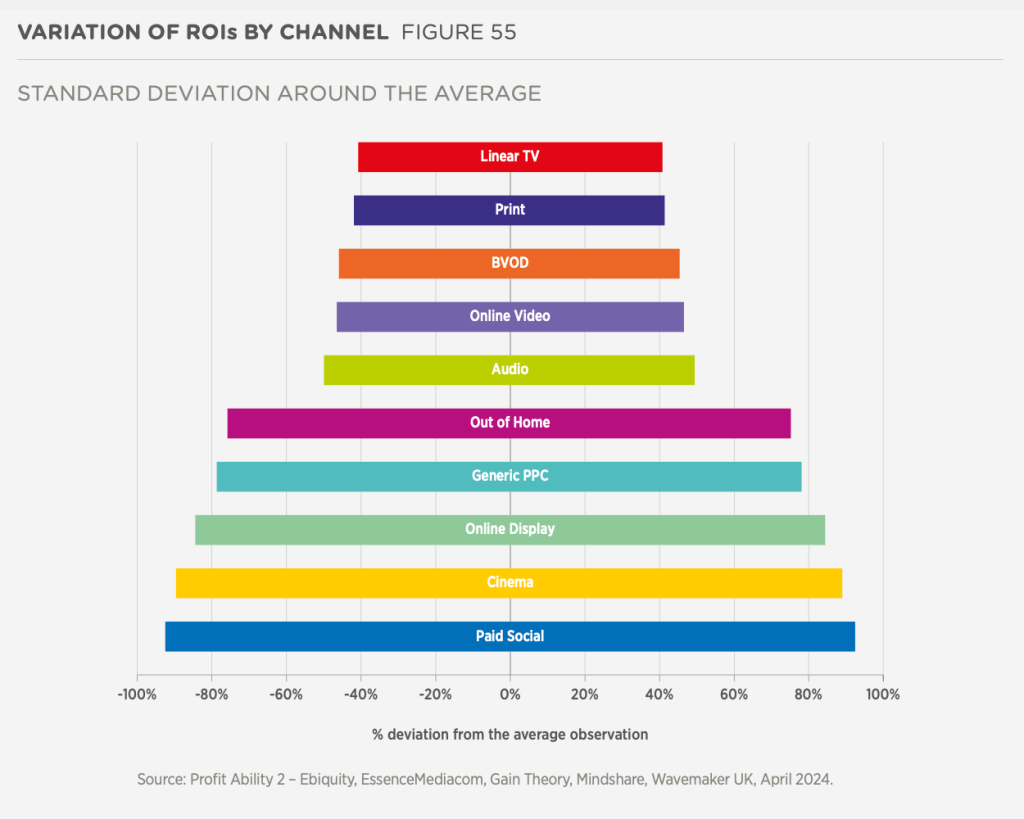
It also shows the highest variability in results – meaning some campaigns perform very well while others perform poorly, with a large spread between the best and worst results, making it the riskiest channel for investment. This doesn’t mean social isn’t effective, and indeed it shows robust performance particularly in sectors like telecoms, travel and FMCG where it often outperforms other channels. However, for most sectors it typically falls in the middle or bottom of the pack, suggesting many brands might benefit from re-evaluating their investment levels to make their total media mix more efficient.
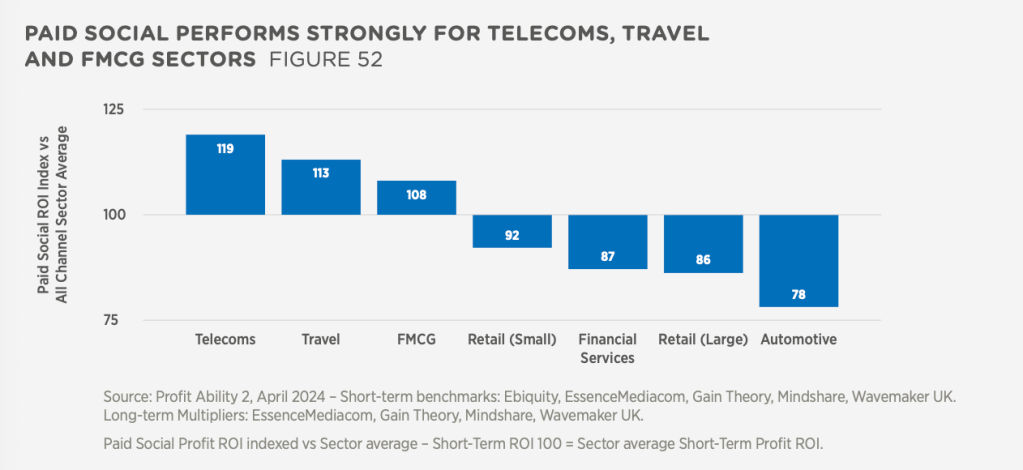
While these insights cover some of the most interesting points for me, there are 133 pages of highly valuable content and research, I would strongly recommend carving some time to digest it so that you can find the most important parts for you. The full Profit Ability 2 research includes detailed analysis across different business sectors, from Automotive to Financial Services to FMCG, making it particularly valuable for understanding what works in your specific industry. You can access the complete research here.
Challenging Your Own Measurement Approach
The insights from Profit Ability 2 give us good knowledge in how to challenge our own measurement approaches. Here are some key questions I’ll be considering when speaking with measurement teams, whether internal or external:
Understanding The Full Picture
Are we genuinely capturing both immediate AND sustained effects across all channels? The research shows traditional ‘brand’ channels can drive significant immediate effects, so we should question if our measurement is set up to capture this in a shorter time frame. Ask to see the timeframes being measured for each channel and challenge any attribution windows that cut off too quickly, especially for TV and BVOD.
Channel Interactions Matter
How are we accounting for the way channels work together? With BVOD showing increasing effectiveness, understanding its interaction with Linear TV becomes crucial. Question how your digital attribution models account for TV’s impact on search and social performance, and ensure your measurement captures the full customer journey across channels, where possible also factors in owned and earned media.
The Incrementality Question
Perhaps most importantly – what would have happened anyway? Challenge any measurement that takes credit for existing customer behavior or doesn’t properly account for seasonality and external factors. The research shows that some digital channels might not be as incremental as we think, so understanding your true baseline is crucial.
Risk and Confidence
The data around social media’s variable performance raises an important question – how confident are we in our numbers? Request confidence intervals for ROI predictions and ask about performance variation across campaigns. Understanding which channels show the most consistent results can be just as valuable as knowing their average performance.
Looking Forward
How can we use this insight for future planning and set up the right cadence to do so? The research shows the importance of sustained effects, so challenge any measurement that only provides backward-looking insight and short-termism. Request scenario planning tools that incorporate both immediate and long-term effects.
These questions, if challenged and actioned correctly could have real implications for how we allocate budgets and measure success. Starting these measurement discussions early in the planning process and creating a consistent feedback loop between insight and action is crucial for improving advertising effectiveness.
Modern Brand Method
We work in an industry that is rapidly changing, and I think it’s excellent that we now have some benchmarks for the ‘new normal’ to help guide us in challenging our media strategies and channel choices to drive better profit and growth. A key takeaway when reading this research for me, was ensuring that we are continuously challenging the experts we work with in measurement to get the highest standard of output that we can. This research provides above and beyond anything, a guide to how we should all be challenging ourselves to better measure and therefore plan both the immediate and long-term effects of our advertising.
 Welcome...
Leave a comment